✦ Wellness For Women | No 1 Women's Blog in Africa ✦
For every woman whose pain has no bruises to show
Elderly Nigerian Woman Reveals a Quiet 14-Day Method That Helps Married Women Stop Blaming Themselves for Their Husband's Anger — Even When Everyone Says 'At Least He Doesn't Beat You'

You hear his car pull into the compound.
Your chest tightens. Not dramatically. Just a small, familiar squeeze. Like your body is bracing for something your mind hasn't decided on yet.
You listen to the way he closes the car door.
Soft? Normal? Or that heavy, deliberate slam that means something happened on the road, or at work, or in his head and now you are going to pay for it.
You are already calculating. Already adjusting. Already running the mental checklist you have run ten thousand times before:
Is the food ready? Is it what he wants? Are the children quiet? Is the house clean enough? Did I say something wrong this morning?
You have sent the children to their room. Not because they did anything wrong. But because you don't know which version of him is walking through that door.
He walks in. You scan his face. His jaw. The tension in his shoulders. The way he drops his keys. You have become so skilled at reading this man's body language that you could write a textbook on it.
And somewhere in the back of your mind, a quiet voice says the thing you cannot say out loud:
I am afraid of my own husband. And he has never once laid a finger on me.
You have tried to explain this to someone. Once. Maybe twice. And every time, you got the same six words that have kept you silent, trapped, and doubting your own sanity for years:
"At least he doesn't beat you."
So you stopped talking about it. You stopped searching. You told yourself you were overreacting. You told yourself this is just how marriage is.
But the fear didn't stop. The eggshells didn't disappear. The flinching didn't stop. And somewhere along the way, you stopped too. You stopped laughing freely. You stopped having opinions. You stopped being the woman you were before this marriage made you small.
Drop everything you are doing right now and listen to every word I'm about to say.
This method was not invented by a therapist on Instagram. It was not pulled from a Western self-help book that doesn't understand your reality. It was not created by someone who has never sat in a Nigerian living room watching her words before she speaks them.
It was built quietly, over nearly forty years, by an elderly woman who spent her entire career sitting with women exactly like you and me. Women whose husbands never hit them. Women whose pain was invisible. Women who had been told by everyone around them that what they were going through wasn't real.
Hi, my name is Nneka.
First thing you should know about me is that I'm NOT a counsellor. I'm NOT a psychologist. I'm NOT a pastor or a life coach. I'm just a regular married woman from Enugu, living in Lagos, who saw hell for sixteen years inside a marriage that looked perfect from the outside and found a way out of that hell through one conversation with one elderly woman at a family gathering.

My husband and I got married in 2010. Beautiful wedding. My family was proud. His family was proud. Everyone said we were a perfect match.
And for the first year... we were.
I don't know exactly when the fear started. I've tried to pinpoint it and I can't. It didn't arrive like a storm. It crept in. Like damp in a wall. Invisible at first. Then everywhere.
Year one, he raised his voice during disagreements. I told myself all new marriages have adjustment periods.
Year two, the silence started. Two days without words. Sometimes four. No eye contact. No explanation. I would spend those days replaying every conversation, searching for what I did wrong.
Year three, he threw a plate of food across the kitchen because I served it late. He apologised the next morning. I told myself it was stress.
Year five, I realised I had stopped disagreeing with him about anything. Not because I had no opinions. Because having an opinion cost too much.
Year eight, I couldn't make a simple decision anymore. What to cook. What to wear to church. Whether to visit my mother. I had to check his mood first. Every time.
By year ten, I had perfected the art of reading him. I knew what his footsteps on the staircase meant. Heavy meant danger. Normal meant I could breathe.
By year twelve, most of my friendships had quietly disappeared. He didn't like Amara — said she was "a bad influence." He didn't like me visiting my sister — said she "talks too much about our private life." One by one, the people who knew the real Nneka fell away.
By year fourteen, I looked in the mirror one morning before church and did not recognise the woman staring back. I wasn't Nneka anymore. I was a function. A cook. A cleaner. A mood-manager.
Everything I tried that failed
The quieter I was, the more reasons he found to be angry. Removing triggers didn't work because the triggers were never logical — they came from inside him, not from anything I did.
I fasted for three straight weeks, asking God to soften his heart. Nothing changed. His heart remained exactly the same.
He prayed with me and said I wasn't "submitting deeply enough." He said "God hates divorce" and sent me home with three Bible verses and a heavier heart.
She said: "Your father was the same way. We managed. You will manage too. That is what wives do."
I ticked 11 out of 14 boxes on a checklist. But every resource I found after that was for women with bruises. Women in shelters. That wasn't me. I closed every tab.
She said "at least he doesn't beat you" and told me to be grateful. I never mentioned it again.
The moment that broke me was not a fight. It was not a slammed door. It was my daughter.
She was thirteen. Sharp and quiet — like I used to be.
One evening after a particularly tense dinner, she followed me into the kitchen and said something that split my chest open:
My 13-year-old daughter had just described in one sentence what I had been unable to name for 16 years. And worse — she had been watching. Learning. Absorbing. Building her own understanding of what marriage looks like.
Three weeks later, I attended a funeral in the village. A distant relative's wife — a woman named Adanna — had died. Everyone said she had been "sick for a long time."
During the reception, I overheard two elderly women talking near the kitchen:
"That woman was not sick. That woman was tired. Her body gave up because her spirit gave up years ago."
"Her husband finished her. Not with his hands. With his mouth. With his silence. With his anger."
I felt those words enter my body like electricity. And a terror I had never felt before — not about my husband, but about myself. About time. About what happens to a woman's body when it carries fear for too many years.
That was when I met Mama Nkechi.
She found me outside the compound, crying without sound. A 74-year-old retired counsellor and researcher. Small woman. Deep smile lines. Reading glasses on the tip of her nose. She took my hand and said:
She explained she had spent 37 years — first as a psychology lecturer at the University of Nigeria, Nsukka, then as a counsellor with the Ministry of Women Affairs — working with women in exactly my situation.
She told me: "What I am going to give you is not medicine. It is not prayer. It is three things — a mirror, a map, and a door."
I followed the protocol quietly over 14 days. On my phone. At night. While the house slept.
Day 1 — I answered the 12-point checklist. I scored 11 out of 12. I sat on the bathroom floor and cried for twenty minutes. Not from sadness. From relief.
Days 5–9, I tracked the pattern. After seven days, I read back my notes and could not believe what I was reading. Tension. Storm. Calm. Tension again. Not random. A cycle.
Day 9 — the breakthrough. He came home angry. Slammed the bedroom door. Normally my stomach would drop. But that night, I watched it happen inside my body and I named it.
There it is. The tension phase. This is the cycle. I can see it.
For the first time in 16 years, I was watching the storm instead of being swept away by it.
By day 14, something had shifted. My husband noticed.
He looked at me one evening and said: "What is different about you?"
I said: "Nothing is different. I am just not afraid anymore."
For the first time in our marriage, I was not the one calculating. He was.
After sharing the protocol with a few women I trusted, something unexpected happened. They told others. Quietly. The way women share things that matter — in whispered phone calls, in DMs, in quiet conversations at school gates.
Within weeks, women I had never met were messaging me: "Please, my sister gave me your number. She said you have something that can help me. My husband has never hit me but..."
I couldn't sit with every woman individually. So I packaged everything — the full framework, the checklist, the tracking method, the naming guide, the safety strategies, the decision-making system — into one simple guide.
Introducing the guide
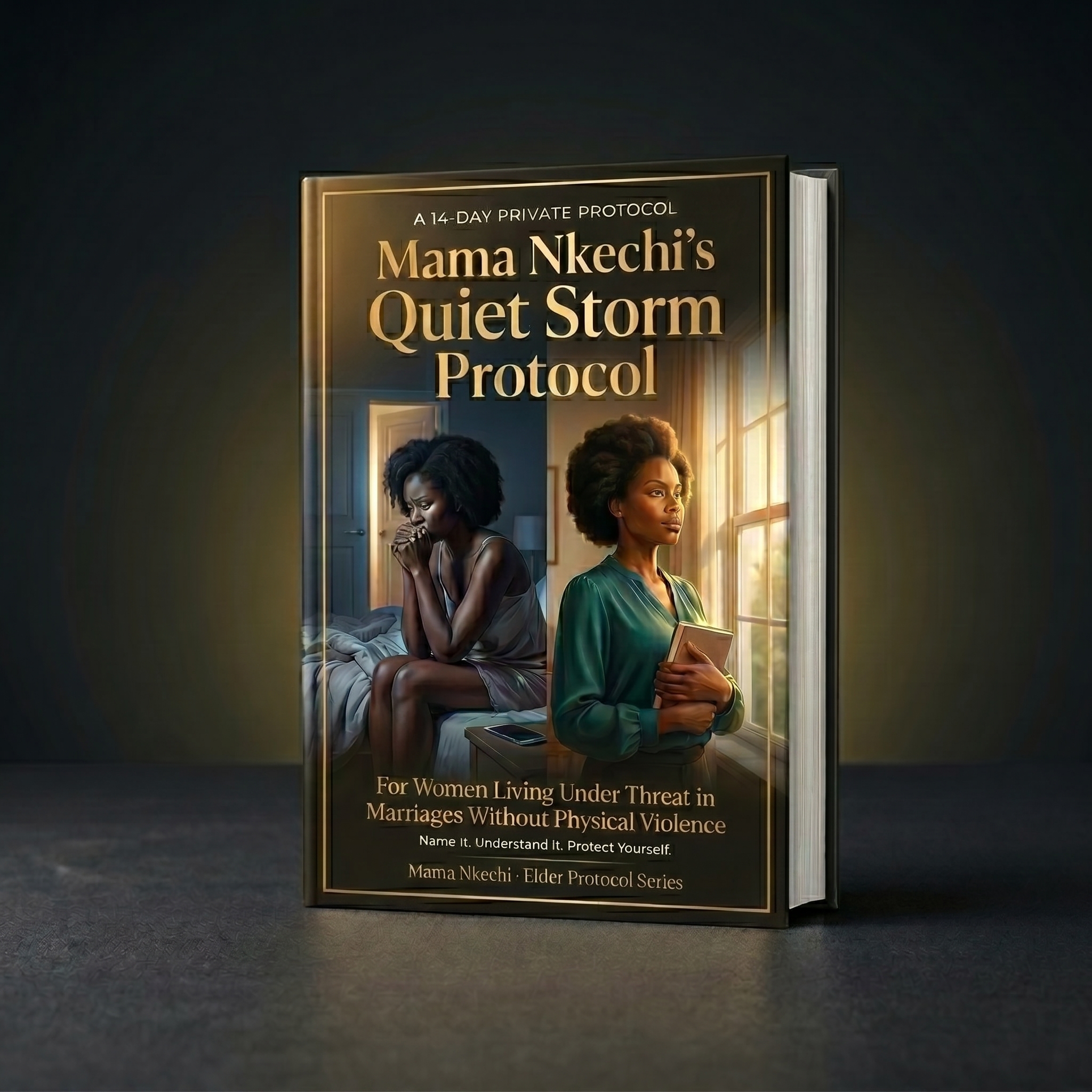
Mama Nkechi's Quiet Storm Protocol
A 14-Day Private Protocol for Women Living Under Threat in Marriages Without Physical Violence
Inside the guide
Every chapter was written for the woman living with this right now
Answer 12 simple yes/no questions in 15 minutes and discover whether what you are living through has a clinical name, a documented pattern, and an explanation that has nothing to do with you being a bad wife.
Pg. 8Why "it's not that bad," "I must be causing this," and "nobody will believe me" are not truths but mechanisms designed to keep you silent and how to dismantle each one permanently.
Pg. 14A simple 7-day private tracking method that reveals the exact cycle of tension, storm, and false calm operating inside your home — in your own handwriting, so you can never unsee it.
Pg. 22The neuroscience behind your shaking hands, your tight chest, and your hypervigilance — explained in plain language that will make you stop blaming yourself immediately.
Pg. 19The exact words to use when telling one trusted person what you are going through — specifically written for Nigerian family dynamics where "just leave him" is not what you'll hear.
Pg. 34A structured, guilt-free framework for evaluating whether to stay and set conditions, or leave and rebuild — without panic, without your mother's voice, without your pastor's voice — only yours.
Pg. 41How to quietly protect your children's emotional health from absorbing the storm, including what to say when they ask the questions you are afraid to answer.
Pg. 38What women are saying
Women who stopped waiting and started seeing
* Names used with permission. Locations verified.
Before I Tell You The Price, Let Me Be Honest With You.
Putting this guide together was not free. I took my time. I was deliberate. I wanted this to be something that actually works — not something thrown together overnight to make quick money.
I consulted with Mama Nkechi — multiple times — to translate 37 years of clinical research and fieldwork into a framework any woman could follow privately on her phone. I hired an editor who specialises in sensitive women's content. I had two research assistants verify every clinical reference. I tested the protocol with 30 women across Lagos, Abuja, and the diaspora before publishing a single word.
Total cost to create this guide: ₦287,500.
I'm not telling you this to impress you. I'm telling you because I want you to understand — what you're about to get is not a motivational pamphlet. It is a structured, evidence-backed protocol built by a woman who spent four decades doing nothing else.
A word about the price. A single session with a therapist in Lagos costs between ₦15,000 and ₦30,000. It gives you one hour, one perspective, and someone who — however skilled — is hearing your story for the first time. This guide costs far less than one session. It gives you a structured, private, no-appointment-needed process you can return to as many times as you need, at 2am or at noon, without explaining yourself from scratch, without anyone else in the room, and without anyone ever knowing you opened it. The question is not whether you can afford this guide. The question is how much longer you can afford the cost of not knowing what is happening inside your own home.
I'm not going to charge you ₦287,500.
I won't even charge you ₦150,000.
Not ₦97,000.
Not even ₦47,000.
In fact, you won't even pay the normal price of ₦19,500.
Right now — today only — you can get the complete Mama Nkechi's Quiet Storm Protocol, plus two free bonuses, for just:
Complete Protocol + 2 Bonuses
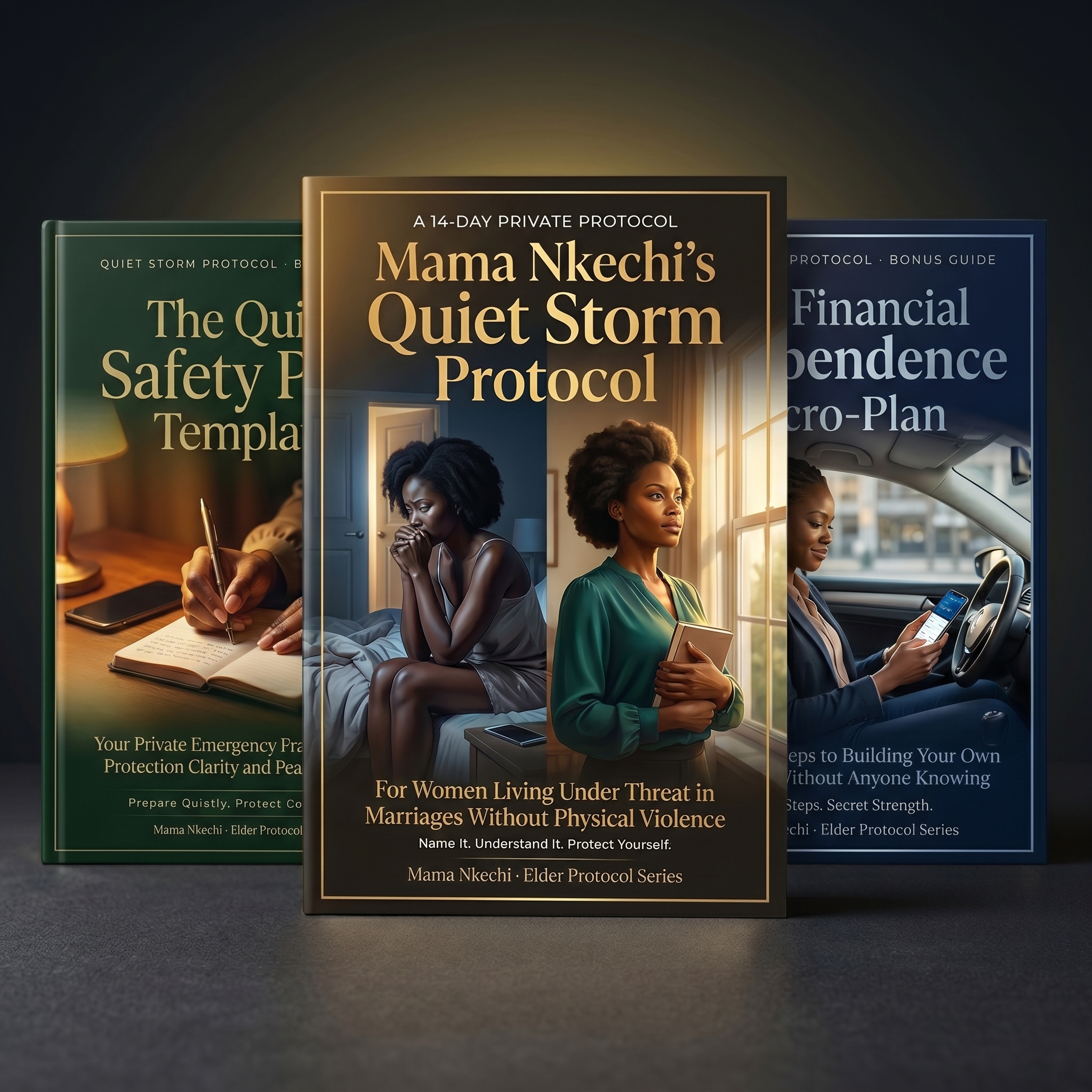
Mama Nkechi's Quiet Storm Protocol
The 14-day private clarity framework
₦19,500
₦8,500
One-time payment · Instant access
✓ Full 14-day protocol ✓ Safety plan template
✓ Financial micro-plan ✓ 14-day guarantee
⚠️ First 20 buyers only at this price
Included free today
Order now and receive two free bonuses
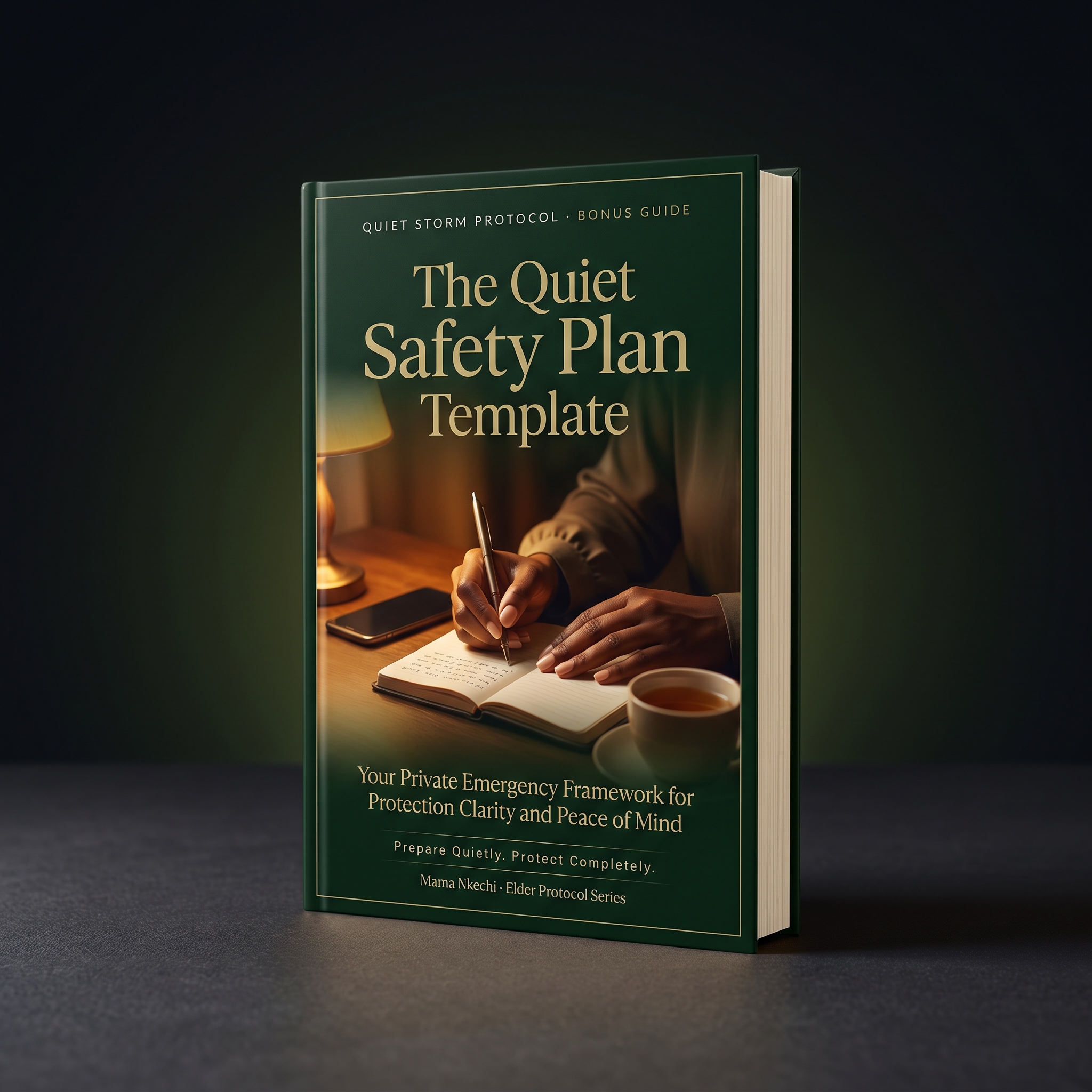
Free Bonus #1 — The Quiet Safety Plan Template
A one-page private protection framework you can keep disguised as a regular notes file on your phone. It covers exactly what to do, who to call, and where to go on your most difficult nights — so you are never caught without a plan.
Valued at ₦15,000 — yours free

Free Bonus #2 — The Financial Independence Micro-Plan
10 small, discreet actions that help you begin building your own financial resources quietly, without alerting anyone — so whatever decision you make, you make it from strength, not dependence.
Valued at ₦12,000 — yours free
14 women have already taken advantage of this discount...
Only 6 spots left at this price.
You're not the only one viewing this page right now.
Secure Your Copy Now →The 14-Day Peace of Mind Guarantee
Read the guide. Follow the protocol for 14 days. If you genuinely feel it did not deliver what was promised — reach out and I will refund every single kobo. No questions. No conditions. No guilt. You should never have to choose between protecting your money and protecting your peace. This guarantee means you don't have to.
More women are speaking up...
From Nigeria and the diaspora
You have two choices right now.
Option 1: Take action. Get Mama Nkechi's Quiet Storm Protocol. Work through the mirror, the map, and the door over 14 quiet days. And for the first time in years — maybe for the first time ever — see your marriage, your situation, and yourself with absolute clarity. Not through your pastor's eyes. Not through your mother's eyes. Through your own.
— OR —
Option 2: Close this page. Go back to monitoring his moods. Go back to sending the children to their room. Go back to Googling things at 2am and closing the tab. Go back to telling yourself "at least he doesn't beat me" and hoping that sentence keeps working.
Maybe God wanted you to see this page today. Who knows?